When digital cameras first appeared, one specification quickly became the number everyone talked about: megapixels.
The bigger the number, the better the camera — or so we were led to believe.
A 5-megapixel camera was replaced by an 8-megapixel camera. Then came 12, 16, 24, 36 and eventually cameras boasting 50, 60 or even more megapixels.
But does having more megapixels actually mean you’ll take better photographs?
Not necessarily.
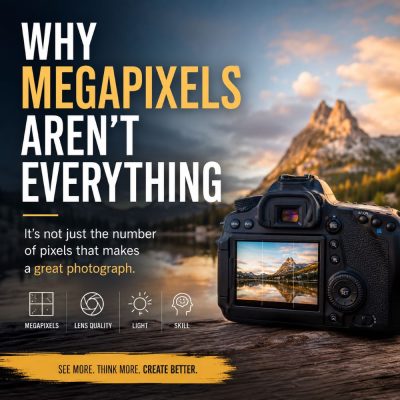
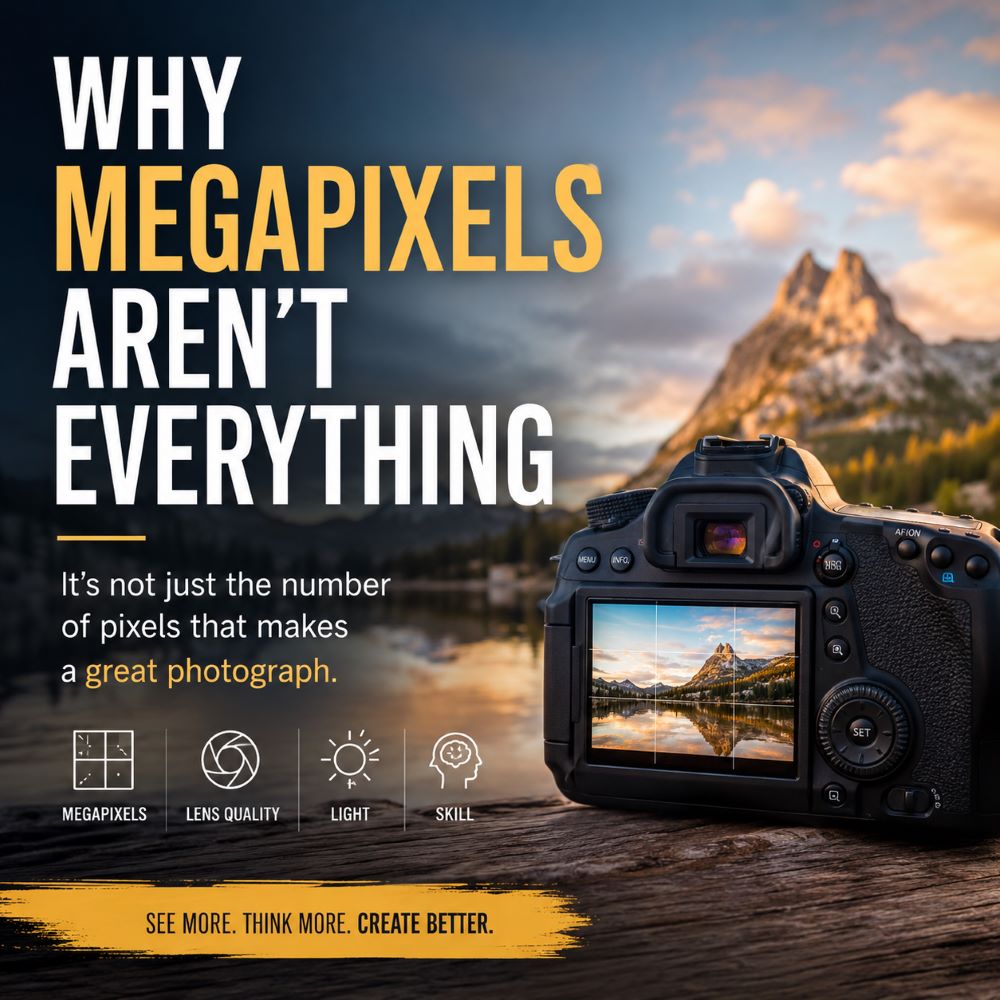
Megapixels matter, but they are only one small part of what makes a great digital photograph.
So, What Exactly Is a Megapixel?
A megapixel is simply one million pixels.
Digital photographs are made up of tiny individual picture elements called pixels. A camera advertised as having 24 megapixels produces an image containing roughly 24 million of these pixels.
For example, an image might be approximately 6,000 pixels wide by 4,000 pixels high:
6,000 × 4,000 = 24,000,000 pixels
That’s 24 million pixels — or 24 megapixels.
It’s easy to assume that doubling the number of pixels must automatically double the quality.
It doesn’t.
More Pixels Mean More Detail — Up to a Point
Higher resolution can certainly be useful.
If you’re photographing wildlife from a distance and later need to crop heavily, having more pixels gives you more information to work with.
Similarly, if you’re producing very large prints, additional resolution can be beneficial.
But for many everyday photographs, you simply don’t need enormous amounts of resolution.
A photograph displayed on a typical computer monitor, tablet or phone doesn’t require anything approaching the maximum resolution of a modern high-end camera.
Even a relatively modest modern camera can produce an image with far more detail than most screens can display.
The Sensor Matters More
One of the most important factors affecting image quality is the camera’s sensor.
The sensor is the electronic component that captures the light entering through the lens.
Two cameras might both have 24 megapixels, but that doesn’t mean they will produce identical images.
A larger sensor can generally gather more light and can offer advantages in dynamic range, noise performance and depth-of-field control.
This is one reason why a 24-megapixel full-frame camera can produce very different results from a 24-megapixel smartphone.
The number of pixels is the same.
The way those pixels are created is not.
Pixel Size Matters Too
Imagine spreading 24 million people across a large football stadium.
Now imagine squeezing those same 24 million people into a much smaller room.
The number of people hasn’t changed — but their environment has.
Pixels work in a similar way.
If you put a very high number of pixels onto a relatively small sensor, each individual photosite becomes smaller.
Smaller photosites can collect less light, which can become particularly important in challenging lighting conditions.
This doesn’t mean that high-resolution cameras are automatically noisy or inferior. Modern sensor technology and sophisticated image processing have made enormous improvements.
It simply means that resolution isn’t the whole story.
Good Glass Makes a Difference
There’s another part of the equation that is often overlooked:
The lens.
A fantastic sensor cannot compensate completely for a poor-quality lens.
The lens determines how much detail and contrast reaches the sensor in the first place.
A 60-megapixel camera paired with a mediocre lens isn’t necessarily going to produce a better photograph than a 24-megapixel camera with an excellent lens.
This is why experienced photographers often invest heavily in good-quality lenses rather than simply chasing the highest possible camera resolution.
Dynamic Range Is Important
A great photograph isn’t simply about detail.
It’s also about how well the camera handles light and shadow.
Dynamic range describes the range of brightness a camera can capture, from very dark shadows to very bright highlights.
Imagine photographing a person standing in front of a bright window.
A camera with good dynamic range may retain detail in both the person’s face and the brighter area outside.
A camera with poorer dynamic range might produce a correctly exposed person but a completely white window — or preserve the window while leaving the person in deep shadow.
No amount of extra megapixels automatically solves this problem.
Noise Can Matter More Than Resolution
Photography often involves working in difficult lighting.
Raise the ISO and the camera has to amplify the signal coming from the sensor.
This can introduce digital noise.
A photograph with 50 megapixels that is covered in distracting noise isn’t necessarily more useful than a clean 24-megapixel image.
For many photographers, the ability to produce a clean image at higher ISO settings is far more valuable than having enormous resolution.
This is particularly true for:
- Wildlife photography
- Indoor photography
- Concert photography
- Wedding photography
- Night photography
- Sports photography
Autofocus Can Be More Important
Imagine photographing a bird in flight.
Your camera has 45 megapixels.
Fantastic.
But if the autofocus misses the bird and focuses on the background, all those extra pixels have captured an extremely detailed photograph of the wrong thing.
The same applies to sports, wildlife, children, pets and many other moving subjects.
Fast and accurate autofocus can be far more important than having the highest resolution available.
Image Stabilisation Matters Too
Another useful feature is image stabilisation.
A camera with effective stabilisation can allow you to photograph handheld at slower shutter speeds without introducing camera shake.
That can be extremely valuable in low-light situations.
Again, the lesson is simple:
A feature that helps you get a sharp photograph is more useful than extra pixels in a photograph that isn’t sharp.
Composition Beats Resolution
Perhaps the biggest mistake we make when discussing camera specifications is forgetting the person behind the camera.
A photograph isn’t successful because it contains 60 million pixels.
It’s successful because it communicates something.
A beautifully composed 12-megapixel photograph can be far more powerful than a poorly composed 100-megapixel photograph.
Look at the great photographs in the history of photography.
Their impact doesn’t come from pixel count.
It comes from:
- Composition
- Timing
- Light
- Emotion
- Subject
- Perspective
- Storytelling
- Creativity
The camera is simply the tool used to capture the moment.
What About Cropping?
This is one area where megapixels genuinely can make a difference.
Suppose you’re photographing a distant bird and the bird occupies only a small part of your frame.
If you crop heavily, a high-resolution image gives you more pixels remaining around your subject.
This can be a significant advantage for wildlife photographers.
The same applies to photographers who frequently produce large prints or need to reframe images after taking them.
But if you regularly compose your photographs carefully in-camera, you may find that you rarely need enormous resolution.
Printing Is Different
Another reason people sometimes want high megapixel counts is printing.
Higher resolution can be useful when producing large prints.
However, you don’t necessarily need a huge number of megapixels to produce an excellent print.
The required resolution depends on the physical size of the print, viewing distance and printing process.
A large photograph hanging on a wall is normally viewed from considerably further away than a small print held in your hands.
So don’t assume that a huge print automatically requires an enormous image file.
Don’t Forget File Sizes
There’s also a downside to having enormous images:
Storage.
A high-resolution RAW file can consume a substantial amount of storage space.
Thousands of those files can quickly fill your computer’s hard drive.
Then there are backups.
More pixels mean larger files, which means more storage, longer transfers and potentially more expensive backup solutions.
For professional photographers this may be a worthwhile trade-off.
For everyone else, it may simply create a lot of unnecessary data.
The Smartphone Megapixel Race
Smartphones provide a particularly interesting example.
Modern phones sometimes advertise cameras with incredibly high megapixel counts.
Yet the physical camera sensors in smartphones are generally much smaller than those found in dedicated cameras.
How do they produce such impressive images?
Through a combination of sophisticated lenses, computational photography, multiple exposures, image stacking, noise reduction, sharpening and artificial intelligence.
The result is a useful reminder that photographic quality is about much more than pixel count.
What Should You Look For Instead?
When choosing a camera, don’t make megapixels your only consideration.
Think about the type of photography you enjoy.
For example:
Landscape photographer?
Dynamic range, resolution and lens quality may be important.
Wildlife photographer?
Autofocus, frame rate, lens reach and high-ISO performance may matter more.
Portrait photographer?
Lens quality, autofocus, colour, dynamic range and depth-of-field control can be more important.
Street photographer?
Size, weight, responsiveness and low-light performance might be priorities.
Sports photographer?
Autofocus, tracking, burst speed and buffer capacity could be far more important than megapixel count.
The best camera isn’t necessarily the one with the biggest specification sheet.
It’s the one that suits what you photograph.
So, How Many Megapixels Do You Really Need?
For many photographers, somewhere around 20–30 megapixels is already more than enough for everyday photography, online publishing and producing excellent prints.
That doesn’t mean higher-resolution cameras aren’t useful.
They absolutely can be.
The point is that once you reach a certain level of resolution, other factors increasingly become more important.
A 24-megapixel camera with an excellent lens, good autofocus, strong dynamic range and a skilled photographer behind it can produce extraordinary images.
And a 60-megapixel camera in the hands of someone who doesn’t understand composition or light won’t magically turn them into a great photographer.
The Photographer Matters More Than the Pixel Count
Perhaps the most important specification on any camera isn’t printed on the box.
It’s you.
Your ability to recognise interesting light.
Your understanding of composition.
Your timing.
Your patience.
Your creativity.
Your willingness to experiment.
Your ability to see something that other people walk straight past.
The camera records the image.
The photographer creates the photograph.
So the next time you see a camera advertised with an impressive megapixel count, don’t automatically assume it’s better.
Ask instead:
Does it help me take the photographs I want to take?
Because when it comes to digital photography, more pixels don’t necessarily mean more photography.