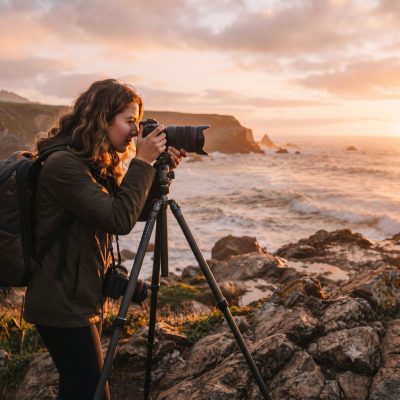
There is something almost magical about the hour around sunrise and sunset. The light becomes softer, warmer and more directional, transforming even the most ordinary scene into something special.
Photographers call this time the Golden Hour — and for good reason.
It is one of the simplest and most rewarding natural opportunities to improve your photographs, requiring no expensive equipment or complicated techniques. All you need is a camera, a little planning and a willingness to get up early or stay out a little later.
What Is Golden Hour?
Golden hour is the period shortly after sunrise and shortly before sunset, when the sun is low in the sky.
Although it is called an “hour”, the actual duration varies depending on your location, the season and the time of year. In some places it may last considerably less than an hour, while in others the beautiful light can persist for longer.
The important thing isn’t the clock — it’s the quality and direction of the light.
When the sun is low, its light travels through more of the Earth’s atmosphere. This reduces the intensity of the cooler blue wavelengths and produces the warm golden, orange and sometimes reddish tones that give the golden hour its name.
Why Is Golden Hour So Special?
The biggest difference between golden-hour light and midday light is softness.
When the sun is high overhead, the light can be harsh and unforgiving. It creates strong shadows, bright highlights and considerable contrast. Portraits taken in the middle of a sunny day can produce deep shadows around the eyes and under the nose.
During golden hour, the sun is much lower and the light is spread more evenly.
This creates:
- Softer shadows
- Warmer colours
- More flattering portraits
- Longer, more interesting shadows
- Greater depth and texture
- Beautiful highlights
- A more atmospheric quality
Even an ordinary field, street or building can suddenly look completely different.
The Direction of Light
One of the most exciting things about golden hour is that you can dramatically change the appearance of your photograph simply by changing your position.
Front Lighting
With the sun behind you, your subject is illuminated from the front.
This can produce bright, colourful and evenly exposed photographs. It’s particularly useful for landscapes where you want to capture detail throughout the scene.
Side Lighting
Move around so the sunlight comes from the side and you’ll begin to see texture and depth.
Side lighting is particularly effective for landscapes, architecture and subjects with interesting textures. The shadows help reveal shape and form.
Backlighting
Perhaps the most dramatic option is to put the sun behind your subject.
Backlighting can create beautiful silhouettes, glowing edges and atmospheric flare. Trees, people, buildings and plants can all become striking subjects when surrounded by warm sunlight.
Don’t automatically try to eliminate lens flare, either. Sometimes a little flare can add atmosphere and help convey the feeling of the moment.
Golden Hour and Portraits
Golden hour is a favourite of portrait photographers because the light can be incredibly flattering.
Instead of positioning your subject directly in the sunlight, try placing them so the sun is behind or slightly to the side.
This can create a beautiful rim of light around their hair and shoulders while keeping their face softly illuminated by the surrounding sky.
You can also use natural surroundings as reflectors. A pale wall, sandy path or even a bright patch of grass can bounce some of that warm light back onto your subject.
The result can be much softer than using direct sunlight.
Golden Hour and Landscapes
Golden hour can transform landscape photography.
The low sun creates long shadows across the landscape, revealing contours that might be invisible under flat midday lighting.
Look for:
- Long shadows
- Trees or buildings catching the sunlight
- Reflections in water
- Mist or haze
- Interesting foreground objects
- Textures in fields and hills
- Clouds catching the warm light
A useful technique is to include something interesting in the foreground. A fence, tree, rock, pathway or person can provide scale and lead the viewer into the photograph.
Don’t simply photograph the sunset itself. Often the most interesting photograph is the landscape away from the sun, where the warm light is illuminating everything around you.
Don’t Forget the Blue Hour
Golden hour doesn’t simply stop when the sun disappears.
After sunset comes Blue Hour, when the sky takes on deeper blue and violet tones.
This can be particularly beautiful for city photography, architecture and landscapes. Artificial lights begin to appear while there is still enough ambient light in the sky to retain detail.
The combination of warm artificial lights and cool blue skies can create a wonderful contrast.
So don’t pack your camera away the moment the sun disappears.
Stay a little longer.
Planning Is Half the Battle
Golden hour photography rewards preparation.
Because the best light can disappear within minutes, arriving at the last moment often means missing the shot.
Before heading out, think about:
Where will the sun be?
Check the sunrise or sunset time and consider where the sun will appear relative to your subject.
Where will you stand?
Think about possible viewpoints before the light becomes beautiful.
What will the weather be doing?
A completely cloudless sky can produce beautiful light, but clouds can make a sunset considerably more dramatic.
What is happening around you?
Look beyond the obvious. A flock of birds, a cyclist, a person walking through the scene or reflections in a puddle can transform an ordinary composition.
Shoot More Than One Photograph
One of the advantages of digital photography is that you can experiment.
Try different focal lengths and compositions. Shoot horizontally and vertically. Move closer. Step back.
Try exposing for the sky, then for the foreground.
Experiment with silhouettes.
Try including the sun in the frame — and then photograph without it.
Don’t assume the first composition you find is the best one.
Golden hour is constantly changing, so the light you see at 7:10 may look completely different at 7:20.
Watch Your Exposure
Golden-hour photography can present some challenging exposure situations.
If you’re photographing directly towards the sun, your camera may struggle to balance a very bright sky with a much darker foreground.
This is where understanding exposure becomes important.
Use exposure compensation or manual exposure to experiment with different results. Sometimes allowing the foreground to become almost completely black creates a much stronger photograph than trying to preserve every detail.
Remember:
A photograph doesn’t always have to show everything.
Sometimes what you leave in shadow is just as important as what you illuminate.
Don’t Chase the Sun — Chase the Light
Perhaps the most important lesson of golden hour is that the sun itself isn’t necessarily the subject.
The real subject is the light.
Look at what that light is doing.
Watch how it falls across a building.
Notice how it catches the edge of a tree.
Look at the shadows stretching across a field.
Observe how a person’s hair suddenly glows.
Watch how a familiar landscape changes as the sun drops lower.
This is where photography becomes less about operating a camera and more about learning to see.
The Golden Hour Challenge
Next time the weather looks promising, give yourself a simple challenge.
Arrive at your chosen location at least 30 minutes before sunset. Don’t take photographs immediately. Spend some time looking.
Watch the light.
Find interesting subjects.
Move around.
Then, as the sun gets lower, start photographing and continue until the light has disappeared.
Try to create at least five completely different images from the same location.
You may be surprised by how much the scene changes in such a short time.
The Magic Is in the Light
Golden hour doesn’t require the latest camera, the most expensive lens or sophisticated editing software.
It simply requires you to be there.
The same landscape photographed at noon and photographed during golden hour can look like two completely different places.
That’s the magic of photography.
We aren’t simply recording what is in front of us.
We are capturing how the world looked at a particular moment — under a particular light.
So set the alarm clock, check the sunset time, grab your camera and go outside.
The golden hour won’t wait for you.