If you’ve ever looked at your camera’s settings and wondered what f/2.8, f/8, or f/16 actually mean, you’re not alone. The f-stop, also known as the aperture, is one of the three key elements of the exposure triangle, alongside shutter speed and ISO. Once you understand how it works, you’ll have far greater creative control over your photographs.
What is an F-Stop?
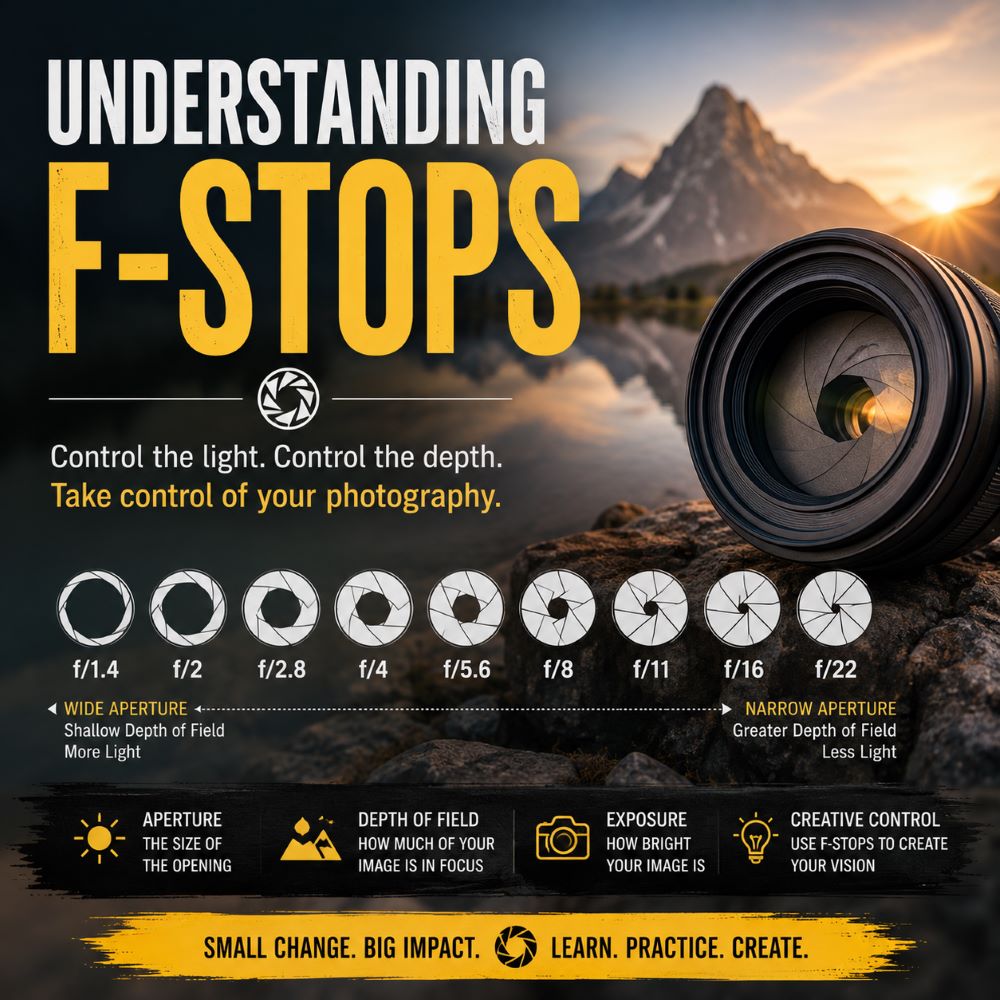
The f-stop is a measurement of the size of the opening (aperture) inside your camera lens. This opening controls how much light enters the camera and reaches the image sensor.
- A low f-number (e.g. f/1.8 or f/2.8) means a large aperture, allowing lots of light into the camera.
- A high f-number (e.g. f/11 or f/16) means a small aperture, allowing much less light through.
It may seem backwards at first, but the smaller the number, the larger the opening.
Common F-Stop Values
Most lenses offer a range of aperture settings, such as:
f/1.4 – f/2 – f/2.8 – f/4 – f/5.6 – f/8 – f/11 – f/16 – f/22
Each full stop lets in either twice as much light or half as much light as the next setting.
For example:
- f/2.8 lets in twice as much light as f/4.
- f/8 lets in half as much light as f/5.6.
F-Stops and Depth of Field
One of the biggest creative effects of changing your aperture is the depth of field—how much of your image appears sharp from front to back.
Wide Aperture (Low F-Number)
Using f/1.8, f/2.8, or f/4 creates a shallow depth of field.
This is ideal for:
- Portraits
- Wildlife photography
- Close-up detail shots
- Isolating your subject from the background
The result is a beautifully blurred background, often referred to as bokeh, helping your subject stand out.
Narrow Aperture (High F-Number)
Using f/11, f/16, or even f/22 creates a deep depth of field.
This is perfect for:
- Landscape photography
- Architecture
- Group photographs
- Scenic views
More of the image remains sharp from the foreground right through to the horizon.
Choosing the Right F-Stop
Different subjects benefit from different aperture settings.
Portrait Photography
Try f/1.8 to f/4 for soft backgrounds that make your subject really stand out.
Landscapes
Use f/8 to f/16 to keep everything from the foreground flowers to distant mountains in focus.
Macro Photography
Macro photography often requires f/8 to f/16 to increase the very limited depth of field when photographing tiny subjects.
Low-Light Photography
A wider aperture such as f/1.8 or f/2.8 allows more light into the camera, making it easier to shoot indoors or after sunset without increasing the ISO too much.
Does Aperture Affect Sharpness?
Yes. Most lenses are at their sharpest when stopped down slightly from their widest aperture.
For many lenses, the “sweet spot” is somewhere between f/5.6 and f/8, where image sharpness is often at its best.
At very small apertures, such as f/22, images may become slightly softer due to an optical effect known as diffraction.
Aperture and Exposure
Changing your aperture affects more than depth of field—it also changes your exposure.
If you close the aperture from f/4 to f/8, less light reaches the sensor, so you’ll need to compensate by:
- Using a slower shutter speed
- Increasing the ISO
- Adding more light
Balancing aperture, shutter speed, and ISO is the foundation of good exposure.
Practice Makes Perfect
The best way to understand aperture is to experiment.
Choose a stationary subject and photograph it several times using different f-stop settings while keeping the composition the same. Compare the images and notice how the background blur and overall sharpness change.
With a little practice, choosing the right aperture will soon become second nature.
Final Thoughts
The f-stop is far more than just a number on your camera—it is one of the photographer’s most powerful creative tools. Whether you’re producing dreamy portraits with silky smooth backgrounds or crisp landscapes packed with detail, understanding aperture allows you to decide exactly how your photographs will look.
So next time you’re out with your camera, don’t just leave it in Auto mode. Experiment with different f-stops and discover how this simple setting can transform your photography.